
A brain divided
Imagine using only half of your brain. Now imagine using all of it.

Written from beautiful Ucluelet, British Columbia. Where are your summer adventures taking you?

You don’t have to work too hard to imagine. We live— at least those of us who do— in a first world society that has prioritized one part of the brain to the exclusion of the other, in a way vastly impoverishing our individual and collective lives. This is the thesis of Iain McGilchrist, putting neuroscience behind the spiritual atrophy of our times.
It’s the post-enlightenment swing toward reason, and when you hear that word, “reason,” do you nod in vigorous understanding of what really matters? At last, you think, our world has returned to reason.
You’re only partly right to think thus, and you’re also behind. Reason is one part of how we understand ourselves and the world, but only one. Markets run on very human and often irrational tendencies (search this and you’ll find endless considerations on how irrational or partly rational the market is). Politics run on story, the reason Marshall Ganz’s frameworks are so compelling to businesspeople and politicians alike. Science looks into hypotheses and makes theories; very little is “known.” (one of my favorite interviews about this is physicist Marcelo Gleiser and author Marilyn Robinson’s conversation on OnBeing.)
When I first came across Iain McGilchrist in Paul Kingsnorth’s Against the Machine recommended in this post, and followed up by listening to podcasts and reading articles about him (alas, our rural library does not carry his physical books though I look forward to reading when I’m back from travels), I thought he was a fairly obscure eccentric discovered and discussed by another somewhat obscure eccentric, which may in fact, be true. But he is popping up everywhere: in a conversation on The Sacred podcast, with Elizabeth Oldsfield (from 2023— I’m just catching up), in a conversation with Arthur Brooks, as reported by my mother at a Catholic conference in California (and who spoke together at my alma mater this spring).
McGilchrist is a neurologist and a philosopher. Why has this bearded wild man from the United Kingdom seemingly suddenly appeared in both mainstream and obscure references? Because he’s making a complex theory simple: the idea, and the charge— a serious one— that modern society has conditioned us to use only half of our brains, and we are realizing just how true this might be. We are so busy being reasonable and rational, doing things that align with money making and technology related endeavors, that we’ve left our right brain to atrophy. We need story and imagination and faith to survive. Especially at a time when we seem poised to cede a great deal of our individual and collective humanity to 1s and 0s, we desperately need to reclaim our sacred imagination.
All the life is in the gaps.- Iain McGilchrist
What of the left and the right brain? We’ve thought of the left brain as the rational mind, connecting pieces of information logically and making inferences, logically. It’s the kind of thing a computer might be trained to do in many cases, if you were to isolate that part of us from the rest. Of course our brain isn’t isolated from the rest of us— we’re made up of a body and a mind, a heart and a spirit (this is my four quadrants I use for planning and thinking). How do we move through the world, how do we think, and love, and transcend? (I just finished Andy Crouch’s The Life We’re Looking For, which I highly recommend, and he thinks similarly: heart, mind, soul, strength).
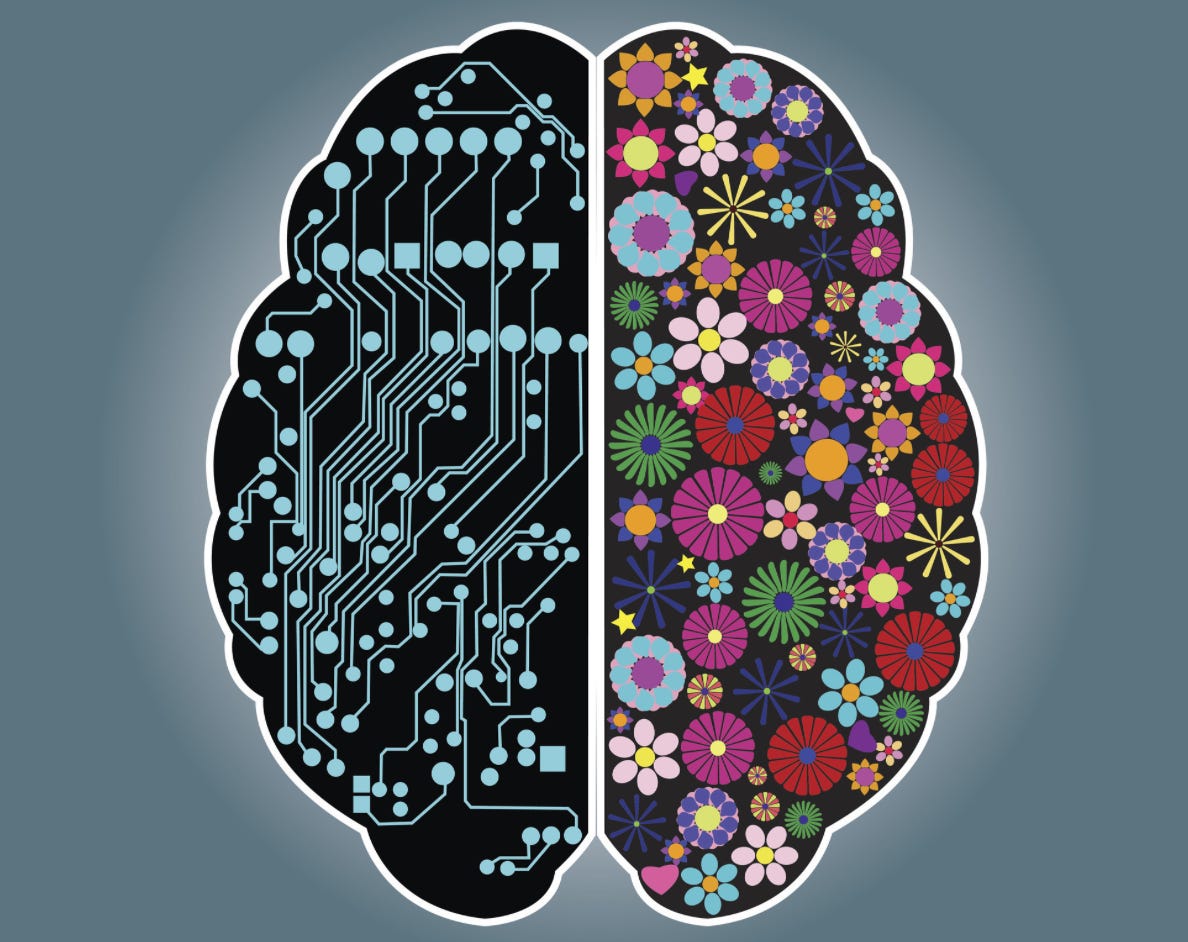
right brain and left brain, image from Harvard
But the left part of our brain is also not separate from the right side— which we have thought of as the side which dreams and imagines and registers awe. Unfortunately, we’ve left out this piece of ourselves, at least as a western culture, for far too long. Oddly, we seem to honor it in other cultures while dismissing it for ourselves— note our possibly condescending fetishes with native cultures on our own and other continents. Oftentimes we see ourselves touristing into these cultural practices and neglecting our own.
McGilchrist calls our current state induced by modern failings “the divided brain,” and suggests our brains are not meant to be divided, but united— itself a logical supposition (left brain). Imagine how our world might expand! (right brain) But this is not the point.
Our first challenge is that our past understandings: logic versus imagination, are no longer understood to be correct. The left brain is not all logic and the right brain all imagination, McGilchrist says. In fact, both halves are needed for both purposes.
Instead, the left brain is what narrows things down to pants of clarity for rational purposes, what manipulates things, makes and uses tools for discrete purposes. The right brain takes a more expansive view, understanding individuals and ideas, empathizing, but never able to achieve full clarity. It’s Einstein’s idea, says McGilchrist, that paved the way for this kind of understanding, when Einstein purportedly said: “The rational mind is a faithful servant, and the imaginative mind is a sacred gift. We have created a society that honors the servant and has forgotten the gift.”
The conversations about Nolan’s adaptation of The Odyssey are coming up at exactly the right time to illustrate this point. More on that soon— I’m hoping to see it next week.
Have you forgotten the gift? How might you honor and cultivate it in yourself an those around you?
Meanwhile, enjoy this TED illustrative rendering of the Divided Brain (Chrome browser required).
With love and to your grit factor,
Shannon